

TL;DR:
Generative Engine Optimization (GEO) helps your brand show up inside Google’s AI Overviews by optimizing not just for rankings, but for context, intent, and authority. It blends technical SEO, structured data, and strong topical depth so AI systems recognize your content as the best possible answer. With the right schema, trust signals, and expertise-driven content, GEO increases your visibility across AI-powered search experiences.
Why GEO Matters: Search Is No Longer a List of Links
Search has quietly undergone its biggest shift since the introduction of PageRank.
For years, SEO was about rising to the top of Google’s 10 blue links. But Google is turning that model on its head.
Instead of “Here are some pages you might like,” we’re entering the era of “Here is the answer.”
AI Overviews summarize everything instantly. They synthesize information. They choose sources based on clarity, intent-match, and authority not keyword density or backlink volume alone.
For businesses in Raleigh, Durham, Boise, or any competitive market, this shift creates a new challenge:
If your content isn’t optimized for AI interpretation, it simply won’t be chosen.
You might rank on page one and still never appear inside an AI Overview.
Your competitor, with better structure and clearer intent signals, will become “the answer” even if your content is objectively more helpful.
That’s why GEO matters. It’s not a replacement for SEO; it’s the next layer of discoverability that ensures search engines can actually use your content, not just crawl and index it.
What GEO Actually Is and What It Is Not
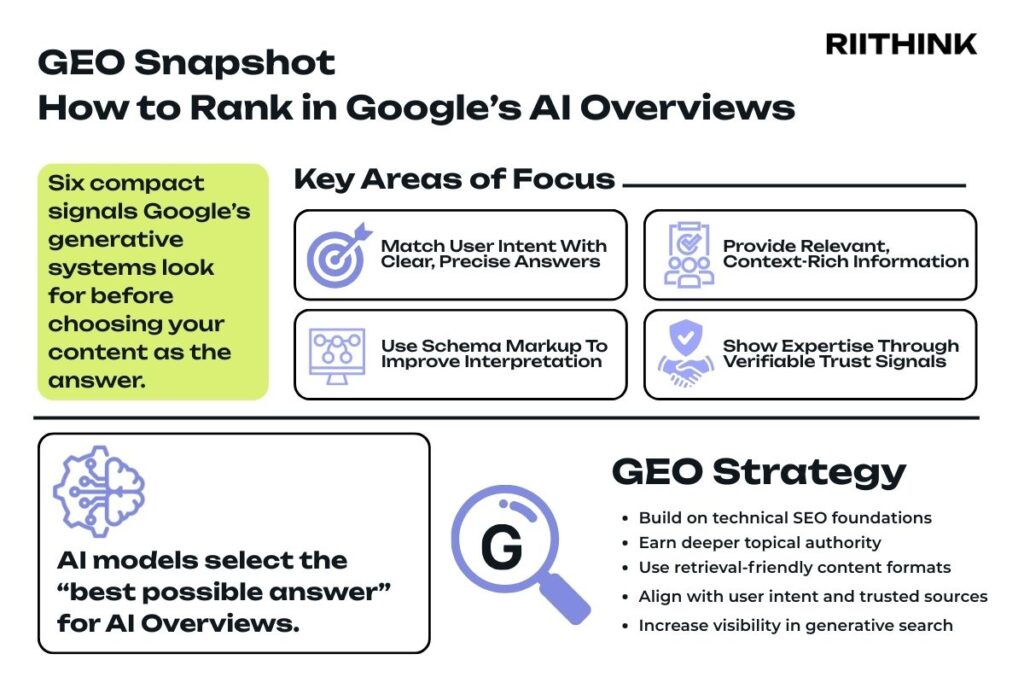
Generative Engine Optimization is the process of helping AI models understand, retrieve, and repurpose your content accurately when generating responses.
It is not about tricking AI systems.
It is not about stuffing “AI-friendly keywords.”
It is not about producing robotic text “for machines.”
GEO focuses on:
- Making content structurally clear
- Helping AI models understand relationships between ideas
- Providing evidence and credibility
- Designing answers that can be extracted cleanly
- And building the authority signals AI systems use to select trusted sources
Think of GEO as giving Google everything it needs to confidently say:
“This is accurate. This is trustworthy. This fits the user’s intent. Use it.”
Traditional SEO gets you visibility.
GEO earns you selection.
How Google’s AI Overviews Actually Work
Google has said repeatedly that AI Overviews do not replace traditional search rankings they enhance them.
SGE combines:
- Large language model reasoning
- Traditional ranking systems (quality, relevance, authority)
- Freshness signals
- E-E-A-T verification
- Structured data understanding
- Topic depth
- Source consistency
- Content eligibility filters
Rather than pulling from one page, SGE looks at patterns across multiple sources:
- Who explains the topic clearly?
- Who provides context the user might need?
- Who demonstrates proven expertise?
- Which pages align with the user’s intent not just the keyword?
- What content is structured cleanly enough to be summarized confidently?
If your content gives AI models something usable, you stand a far better chance of being featured.
If it doesn’t, SGE will simply skip you.
The New GEO Ranking Factors: What Google Actually Rewards
GEO isn’t a mystery. When you strip away the noise, five clear ranking signals rise above everything else.
1. Intent Depth, Not Just Intent Match
Traditional SEO teaches us to match search intent.
GEO goes further you must match all adjacent intents too.
For example, if someone searches “local SEO for small businesses,” Google considers:
- What does the user want to achieve?
- What supporting questions will they likely ask next?
- What scenarios or edge cases might matter?
- What frameworks or steps are relevant?
- What alternatives might be useful?
Generative engines prefer content that answers the primary question and the surrounding questions that help users make decisions.
Shallow content gets ignored.
2. Entity Optimization (AI Understands Concepts, Not Keywords)
Generative models do not rely heavily on keyword strings.
They use entities recognizable concepts such as:
- People
- Locations
- Brands
- Technologies
- Methods
- Products
- Industries
- Problems
- Frameworks
When your content places entities inside clear relationships, AI models understand it better and trust it more.
If you mention Raleigh, Durham, Boise, or your industry ecosystem, do it in a way that reinforces context not for keyword stuffing, but for meaning.
3. Structured Data and Machine-Friendly Formatting
Schema is no longer optional.
AI Overviews rely on structured data to understand:
- What the page is
- Who wrote it
- What the page contains
- The purpose of each section
- How it relates to other content
The most useful schemas for GEO include:
- WebPage
- Article
- Author
- FAQPage
- HowTo
- LocalBusiness
- Organization
- Service
- Product
- Review
Pair that with:
- Clean HTML
- Predictable heading hierarchy
- Internal linking
- Fast load times
- Error-free rendering
And your content becomes significantly more “AI-ready.”
4. Real Authority and Verifiable Expertise
E-E-A-T becomes dramatically more important in generative search because AI needs proof not assumptions of trustworthiness.
SGE favors content that includes:
- Clear author identity
- First-hand experience
- Real examples
- Case studies
- Data that can be cross-referenced
- Regional relevance (Raleigh, Durham, Boise, etc.)
- External signals: citations, profiles, reviews, mentions
When your content demonstrates lived experience, AI systems treat it as more reliable.
5. Extractable Answers (Quote-Friendly Content)
AI can’t quote what it can’t cleanly extract.
Your content needs:
- Crisp definitions
- Step-by-step frameworks
- Comparison tables
- Helpful lists
- Short “in plain English” explanations
- Question-based headings
- Precise, non-fluffy answers
When AI can easily summarize your content without misinterpreting it, you dramatically increase eligibility.
How to Optimize for GEO: Riithink’s Complete Framework
Here’s where strategy turns into execution.
This is the exact framework we apply when optimizing client sites for AI Overviews.
Step 1: Build Deep Topical Authority Instead of Wide, Scattered Content
Most websites publish isolated articles that never connect.
AI Overviews ignore those.
GEO requires topical ecosystems not single posts.
A complete topical hub includes:
- A primary pillar page
- Multiple supporting articles
- FAQs
- Real examples and case studies
- Tools or frameworks you use
- Problem-solution pieces
- Location-specific versions where relevant
- “What,” “How,” “Why,” and “Which” content
When Google sees complete topic coverage across an ecosystem, it signals:
This brand is the authority.
That’s the level generative models prefer.
Step 2: Add Machine-Friendly Structure Everywhere
LLMs thrive on structure. Humans like it too.
Your pages must be:
- Predictable
- Clean
- Hierarchical
- Schema-rich
- Easy to scan
- Fast-loading
- Free of rendering issues
This is where our Technical SEO Services make a measurable difference especially for large content libraries or complex sites.
Step 3: Use First-Principles Explanations
GEO doesn’t reward vague statements.
Example:
Not GEO-friendly:
“Google SGE is a tool that uses AI to show search results.”
GEO-friendly:
“Google SGE uses large language models to analyze, summarize, and verify information across multiple web sources. Instead of ranking pages in a linear list, it selects the most intent-matching, trustworthy content to synthesize into a single answer.”
One sentence explains what it does.
The second sentence explains how it thinks.
That’s first-principles clarity.
Step 4: Build Local Authority if You Serve Local Markets
Google personalizes AI Overviews based on where the user is searching.
If you’re serving Raleigh, Durham, or Boise, local signals dramatically boost your GEO visibility.
You need:
- Local case studies
- City-specific pages
- LocalBusiness schema
- Google Business Profile optimization
- Local backlinks
- Local media mentions
- NAP consistency
Local relevance = higher selection probability.
Step 5: Human Experience Signals Everywhere
AI can’t fabricate lived experience so it rewards content that includes it.
Add:
- Stories
- Observations
- Mistakes you learned from
- “We tried this, here’s what happened”
- Client outcomes
- Before/after breakdowns
- Evidence from your own operations
These signals are extremely hard for competitors (and AI generators) to replicate.
They also strengthen E-E-A-T more than any keyword strategy ever could.
Step 6: Make Your Website Crawlable and Cohesive
No matter how strong your content is, AI can’t use it unless Google can fully crawl and interpret your site.
You need:
- Clean URL structures
- Correct canonical tags
- Logical internal linking
- Fast mobile performance
- Minimal JavaScript rendering issues
- Zero indexing errors
GEO isn’t just content it’s infrastructure.
What Types of Content Perform Best in AI Overviews
Certain formats consistently outperform others because they’re easier for AI systems to summarize.
1. How-To and Framework Guides
Great for intent clarity and extractable steps.
2. Problem-Solution Content
Generative search prioritizes content that resolves friction.
3. Comparison and Decision-Making Content
Helps AI understand alternatives, pros/cons, and scenarios.
4. Expert Perspectives
AI heavily favors lived experience and professional reasoning.
5. Technical Breakdowns
Clear logic = higher accuracy = higher selection rates.
Mistakes That Keep You Out of AI Overviews
Most brands unintentionally sabotage their own visibility.
1. Writing for keywords instead of meaning
AI cares about semantic clarity, not repetition.
2. Producing shallow, interchangeable content
If your article could be written by anyone, AI ignores it.
3. Skipping schema markup
No structure = no eligibility.
4. No author identity or expertise
Anonymous text loses trust instantly.
5. Sounding salesy or over-optimized
AI systems actively deprioritize manipulative writing.
Where GEO Is Heading Next
We’re only at the early stages of AI-assisted search.
In the coming months and years, we’ll see:
- Personalized AI Overviews based on user behavior
- Higher weight on local intent
- More emphasis on first-hand experience
- Expanding entity-based ranking logic
- More cross-referencing against trusted sources
- Deeper integration of structured data
- Continual evolution of generative ranking factors
GEO is not a one-time update.
It’s a long-term shift in how information is evaluated.
Businesses that adapt early especially in competitive markets like Raleigh, Durham, and Boise will build an unshakable advantage.
GEO Is the Competitive Advantage of This New Search Era
Generative Engine Optimization is not a trend. It’s the new reality of how search engines read, interpret, and synthesize information. The brands that win are the ones that make their content understandable to machines and meaningful to humans.
That requires:
- Technical excellence
- Deep topical authority
- Clear structure
- Verifiable experience
- Local relevance
- Machine-friendly formatting
At Riithink, we build SEO and GEO strategies that help brands become the trusted source AI Overviews choose not by gaming the system, but by giving Google exactly what it needs to generate accurate, high-quality answers.
If you’re ready to align your digital presence with the future of search, we’re here to help you lead not follow the next evolution of SEO.












4 Comments