
TL;DR
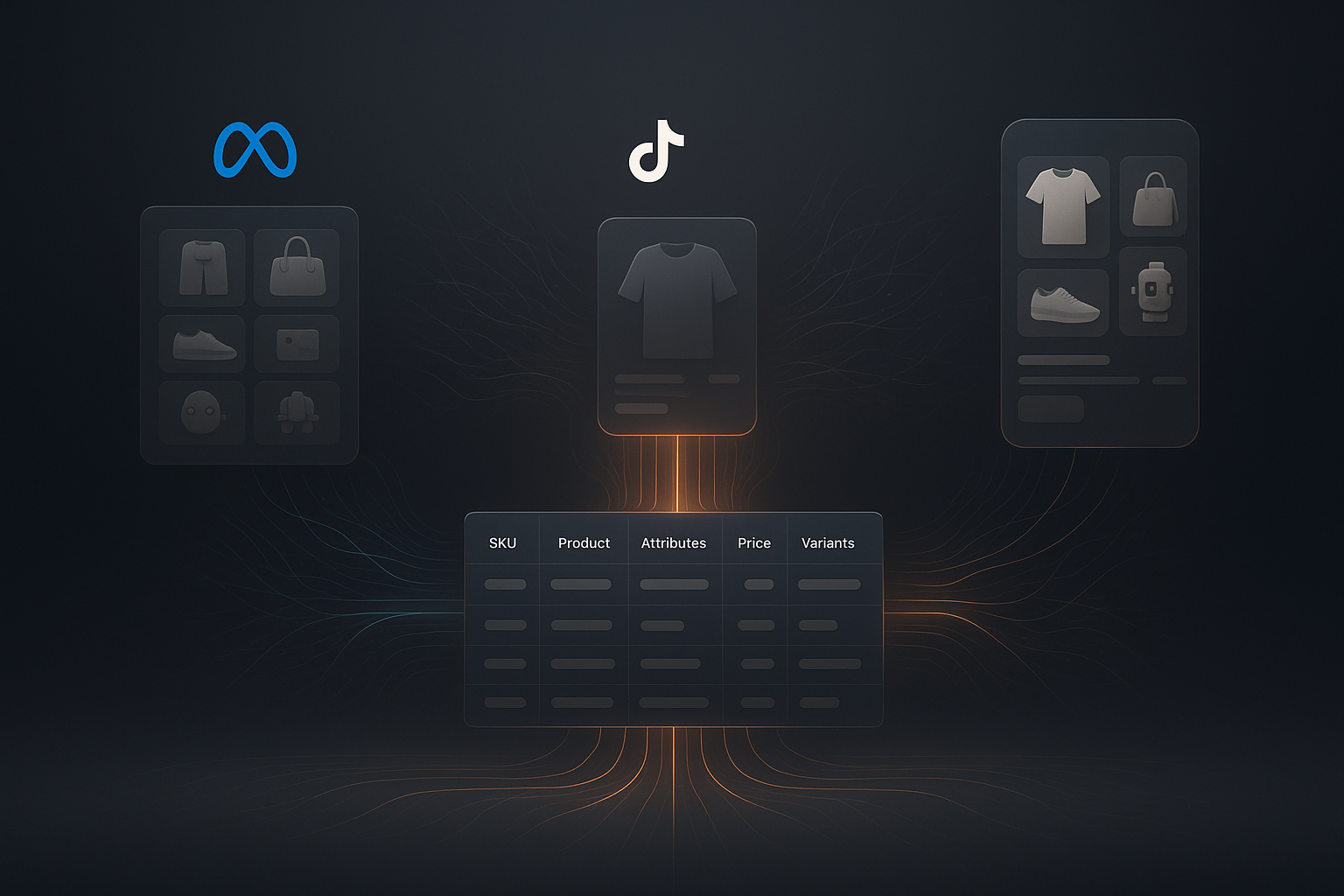
Your ads aren’t underperforming because of targeting or creatives they’re underperforming because your product feed isn’t giving algorithms the data they need to rank, match, and scale your products. Clean, enriched, and consistently monitored product data is the true performance driver across Google Shopping, Meta, and TikTok Shop. Fix the feed, and every channel instantly becomes more efficient and profitable.
Why Your Product Feed Decides Whether Your Ads Win or Lose
You can run the best ads in your category and still watch cheaper competitors outrank you. Why? Because your product feed not your budget is the real algorithmic source of truth across Google Shopping, Meta, and TikTok Shop. And if your product feed management framework isn’t built intentionally, every automated system that depends on it starts working against you.
If the product data is wrong, incomplete, inconsistent, or poorly structured, no amount of “smart” bidding or automation can save you.
And here’s the part nobody wants to hear: AI ad systems don’t fix your feed… they magnify its flaws.
So let me give you the answer clearly, upfront:
A winning eCommerce feed strategy requires a clean, enriched, structured, error-free product dataset that platforms can understand and trust.
This foundation unlocks:
- Higher visibility
- Lower CPC
- Fewer shopping feed errors
- Better product data optimization
- Stronger cross-channel performance
When someone asks, “What’s the real secret behind Google Merchant Center optimization?” this is it.
Not hacks.
Not budget.
Not “AI magic.”
Just high-quality product data, monitored and improved consistently.
And yes this is exactly why so many brands eventually look for expert support through professional E-commerce Feed Management Services, often as part of a broader Digital Marketing Services partnership designed to drive full-funnel performance.
Why Feeds Matter More Than Ads (Even Though Everyone Focuses on Ads)
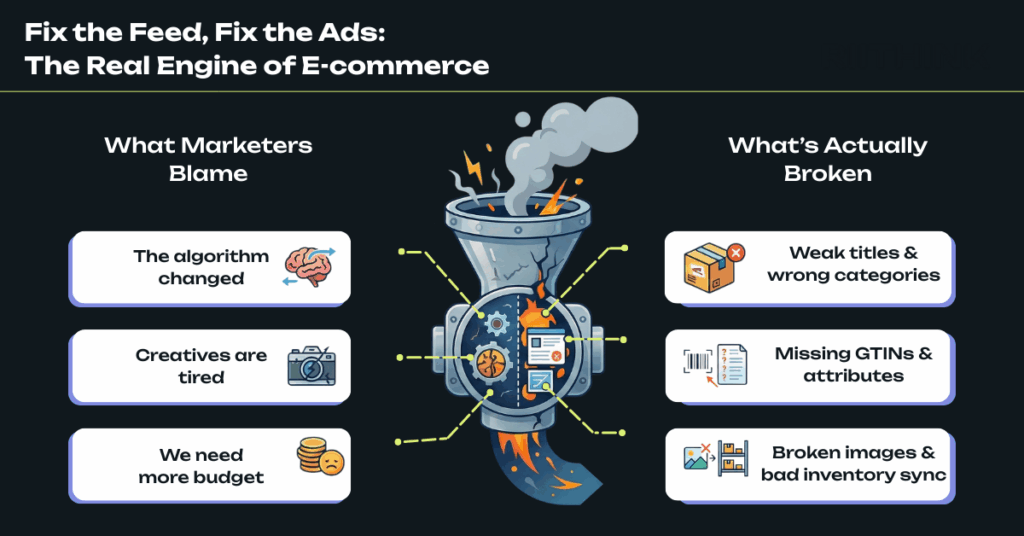
You and I both know marketers tend to blame the wrong thing.
CPC went up? “The algorithm changed.”
ROAS dipped? “The creatives must be stale.”
But a deeper look inside the backend reveals the real issues:
- Weak titles that don’t match user intent
- Missing GTINs
- Incorrect categories
- Bad inventory sync
- Broken images
- TikTok Shop rejecting SKUs
- Meta dropping half your products from the catalog
If your feed is messy, every system relying on it starts making bad decisions.
It’s like giving a self-driving car the wrong map.
It doesn’t get smarter it just gets lost faster.
AI Shopping Engines Only Win When You Give Them Clean Inputs
Google, Meta, and TikTok Shop rely almost entirely on the product feed to decide:
- Who sees your products
- When you appear
- Which queries you match
- How much you pay
- Whether your products stay approved
- How well your ads scale
And even the best AI systems only perform as well as the data they receive.
If your eCommerce feed strategy isn’t intentionally engineered, the platforms simply cannot interpret your catalog correctly and you pay the price.
The Problem Most Brands Ignore Until It’s Too Late
Most businesses treat feed management as a one-time task.
But feeds are living systems.
Every day, something shifts:
- Prices
- Inventory
- Variants
- Image URLs
- Store attributes
- Platform policies
If no one is watching, performance decays quietly… until it collapses loudly.
This is where a strategic approach supported by the right team or the right Digital Marketing Services partner becomes the difference between scaling and stagnation.
Why Product Feed Management Is the “Invisible Hand” Behind Your Revenue
Platforms don’t evaluate your products like customers do.
They don’t see your brand story, lifestyle images, or product quality.
They see one thing: your product feed.
That feed becomes your product’s identity across:
- Google Merchant Center
- Meta Shops
- TikTok Shop
If that identity is incomplete, algorithms make assumptions and those assumptions rarely help you.
The Three Pillars of a High-Performing eCommerce Feed Strategy
1. Accuracy
Accuracy prevents catastrophic issues.
When Google flags errors like:
- Missing GTIN
- Invalid category
- Image too small
- Price mismatch
…it isn’t nitpicking.
It’s warning you that your performance is at risk.
Accuracy stabilizes the foundation.
2. Enrichment
Accuracy keeps you compliant.
Enrichment makes you competitive.
Enrichment includes:
- Upgraded titles
- Descriptive attributes
- Detailed material, pattern, fit, compatibility fields
- Stronger product descriptions
- Keyword-aligned content
The goal isn’t stuffing keywords it’s about giving the algorithms clarity.
3. Daily Sync & Error Monitoring
Feeds break constantly.
You need:
- Automated syncing
- Daily audits
- Error alerts
- Platform-specific rules
- Rapid correction workflows
This is where professional feed teams deliver huge value because someone is actually watching your data.
Google Shopping vs Meta vs TikTok Shop: A Feed Is Not “One Size Fits All”
Each platform reads and ranks your data differently.
Comparison Table
| Feature / Priority | Google Shopping | Meta Shop | TikTok Shop |
| Importance of structured attributes | Very High | Medium | Low |
| Sensitivity to price mismatch | Extreme | High | High |
| Textual enrichment importance | High | Very High | High |
| Categorization rules | Strict | Flexible | Flexible |
| Image demands | High | Medium | Very High |
| Penalties for errors | Severe | Moderate | Instant |
| Primary success driver | Data completeness | User behavior | Trend alignment |
If you’re using a single “universal feed,” you’re capping your growth.
Decoding the Most Damaging Feed Errors
Missing GTIN
Google cannot identify your product → visibility drops drastically.
Price Mismatch
Instant suppression until fixed.
Weak Titles
Poor alignment with search intent → wasted spend.
Broken Images
Platforms penalize unclear, watermarked, or low-quality visuals.
Missing Attributes
Algorithms struggle to classify your product → fewer impressions.
Why Feed Problems Look Like Ad Problems
When ROAS drops, most advertisers assume:
- “Our audience changed.”
- “Our creatives need a refresh.”
- “Maybe the algorithm reset.”
But the root cause usually sits inside the feed:
- Product suppressed
- Variant collision
- Inventory mismatch
- TikTok Shop rejection
- Meta catalog issues
Fix the feed → the ads recover.
How Product Data Optimization Translates Into Revenue
Improving your feed creates:
- Higher relevance
- Lower CPC
- More qualified impressions
- Higher CTR
- Stronger conversions
Better data multiplies every advertising dollar.
The Modern Feed Management Stack
A strong workflow includes:
- Feed automation tools
- Attribute enhancement rules
- Error monitoring
- Channel-specific templates
- Human strategy
Automation alone isn’t enough.
Platforms change too quickly, and prioritization requires judgment.
Advanced Tactics & The Final Framework
1. The Cross-Channel Attribute Play
Each platform rewards different types of data.
Tailor your outputs even if your master feed stays unified.
2. Title Engineering (Your Highest-ROI Lever)
Winning formula:
[Primary Keyword] + [Product Type] + [Attribute] + [Use Case] + [Variant]
This improves:
- CTR
- Relevance
- Conversion intent
Google, Meta, and TikTok all reward clarity.
3. Weekly Feed Scorecard Audit
Monitor:
- Attribute completeness
- Suppressed items
- Price mismatches
- Declining impression share
- Image issues
- Category accuracy
Scaling brands do this weekly not quarterly.
4. Inventory–Feed–Ads Sync Loop
Your ads must match the real-time store environment.
If not, you’ll:
- Waste spend promoting out-of-stock items
- Lose momentum on best-sellers
- Trigger suppressions across catalogs
A tight loop prevents these losses.
5. Smart Platform-Specific Rules
Google Rules
- Auto-populate missing fields
- Normalize brands
- Improve attribute density
Meta Rules
- Benefit-first descriptions
- Shorter titles for thumbnails
TikTok Rules
- Trend-aligned keywords
- Strict image formatting
- Automated variant clarity
Strategy + automation beats automation alone.
6. Behavioral Ranking Is the Future
Platforms rank products based on:
- Clicks
- Saves
- Add-to-cart behavior
- Purchases
Metadata gets you into the auction.
Behavior keeps you there.
7. A Scalable Cross-Channel eCommerce Feed Strategy
A high-performing system includes:
- One master data layer
- Channel-specific transformations
- Seasonal adjustments
- Merchandising logic
- Error workflows
This is where brands often bring in outside help through Digital Marketing Services because efficiency, precision, and monitoring matter more as you scale.
8. Why AI Tools Can’t Replace Human Strategists
AI can identify gaps but it cannot:
- Interpret nuance
- Evaluate competitors
- Prioritize high-margin SKUs
- Understand emotional triggers
- Anticipate platform changes
AI reacts.
Humans decide.
This is why hybrid systems win.
The Local Layer (Raleigh, Durham, Chapel Hill, Boise, or Any Market)
Local visibility depends on:
- Local inventory accuracy
- Pickup attributes
- Localized titles
- Region-specific wording
Feed management isn’t just a national strategy it’s a local advantage.
Ready to Turn Better Product Data Into Better Results?
If you’re looking at your performance thinking, “We’re spending enough… we’re just not getting enough back,” that’s usually a product data problem not an ad problem. When your catalog becomes a performance engine, every channel Google Shopping, Meta, TikTok Shop starts working harder for you.
If you want expert help building that kind of system, our Digital Marketing Services include advanced E-commerce Feed Management designed to improve visibility, lower costs, and strengthen cross-channel results.
And if you want clarity on what’s breaking inside your current setup, you can start a conversation with us. We’ll walk through your data, show you where the losses are happening, and outline how to fix the foundation.